EU Leaders as Chief Guests at India’s Republic Day 2026 and the Strategic Momentum Behind the India-EU Free Trade Agreement
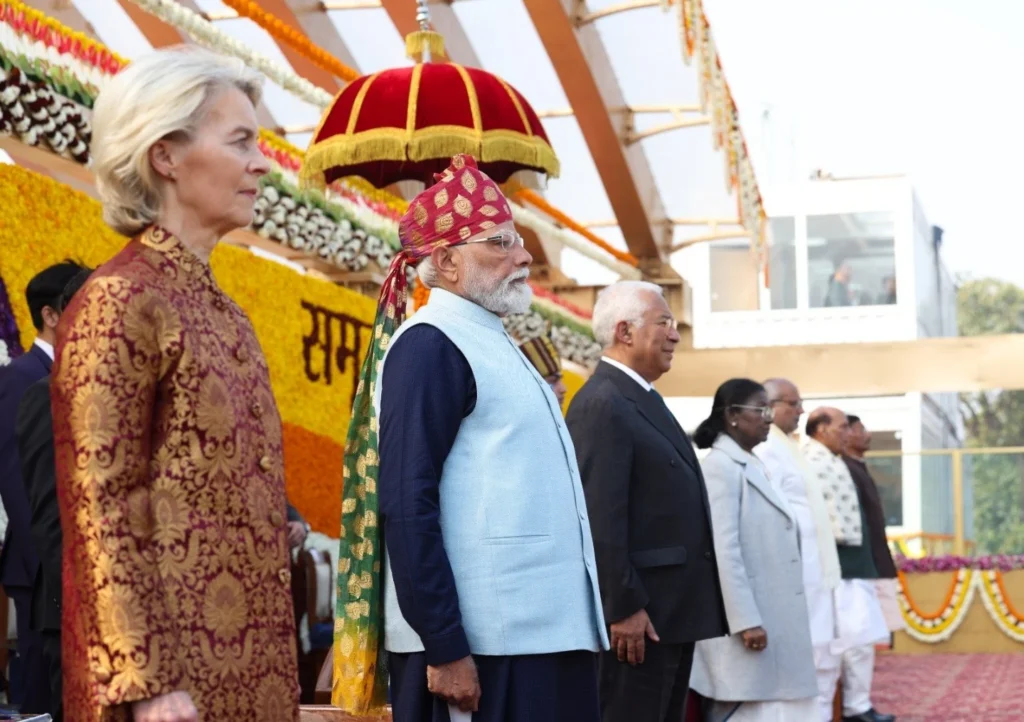
India’s 77th Republic Day on January 26, 2026 was marked by an unprecedented diplomatic gesture as the top leadership of the European Union—European Commission President Ursula von der Leyen and European Council President António Luís Santos da Costa—attended the celebrations as chief guests at the Raj Bhavan and Kartavya Path functions in New Delhi. This high-profile invitation underscores New Delhi’s intention to elevate ties with the EU beyond ceremonial goodwill to a strategic partnership of global consequence.
The presence of the EU’s leadership on Republic Day carries deep symbolic value. It reflects not only mutual respect between two large democracies but also strategic alignment ahead of the concluding stages of the long-pending India-EU Free Trade Agreement (FTA) negotiations. For India, having the EU as chief guests during this national event signals international endorsement of its developmental trajectory and diplomatic weight on the global stage. For the EU, it highlights confidence in India as a key partner in navigating an increasingly complex geopolitical and economic environment.
Economically, the India-EU FTA is being hailed on both sides as transformative. After nearly two decades of negotiations, the agreement has progressed to completion and heralds a “mother of all trade deals” between New Delhi and Brussels, involving economies that collectively represent a significant share of global GDP and trade. The pact is expected to reduce tariffs, enhance market access for Indian exports in sectors such as textiles, pharmaceuticals, and services, and provide European firms with greater foothold in India’s expanding market. This diversification comes at a time when global trade faces headwinds from protectionist measures elsewhere.
Politically and strategically, the timing of the EU leaders’ visit and their participation in Republic Day signifies a deepening of bilateral engagement. Leaders from both sides used the platform to reiterate shared commitments to democratic values, economic cooperation, and stability in the international order. Statements from the EU underscored the belief that a “successful India contributes to global stability, prosperity and security,” a sentiment that dovetails with mutual priorities on climate action, technology cooperation, and regional peace.
The convergence of celebrations and the FTA discussions illustrates how ceremonial diplomacy can dovetail with hard economic outcomes. As India progresses toward implementing its ambitious reform and growth agenda under initiatives like Atmanirbhar Bharat, access to the EU market through a comprehensive trade agreement could reshape investment flows and supply chain strategies for Indian industry. Likewise, the EU gains strategic access to a fast-growing market at a time when global trade realignment is underway.
In essence, the EU chief guests’ role at the Republic Day celebrations and the momentum in finalising the India-EU FTA marks a pivotal chapter in bilateral relations. It signals a shift from traditional diplomatic courtesy to strategic economic partnership, positioning both India and the European Union as consequential players in shaping future trade norms and global governance structures.